
One of the questions I hear regularly from clients is:
“What am I supposed to post about?”
They might have a website with a news or blog section, a Facebook page, Instagram, LinkedIn and a Google Business Profile.
Then there’s email marketing.
Maybe YouTube.
And suddenly it feels as though the business needs to invent something interesting to say every five minutes.
It doesn’t.
One genuinely useful piece of content can go much further than most business owners realise.
The trick is to stop thinking of a blog post as something you publish once and forget about.
Think of it as the starting point.
Start with the website
If you’ve got something worthwhile to say, I generally want the fullest and most useful version of it on your own website.
That matters.
Your Facebook page belongs to Facebook. Your LinkedIn profile belongs to LinkedIn. Your Google Business Profile belongs to Google.
Your website is yours.
It’s also where somebody can move from reading an interesting article to looking at your services, learning about your business, reading testimonials and, hopefully, getting in touch.
So start by writing one useful article that answers a question, solves a problem, explains something, shares some news or demonstrates your expertise.
Then we can make that article work harder.
One article. Lots of opportunities.
Imagine you’ve just written an 800-word article for your website.
That doesn’t mean you now need to sit down and invent something completely different for Facebook.
Take one of the useful points from the article and turn it into a Facebook post.
Pull out another angle for LinkedIn.
Create a shorter version for your Google Business Profile with a Learn more button pointing to the original article.
Turn three of the main points into an Instagram carousel.
Use the introduction in your next email newsletter.
If there’s something particularly useful in the article, you might even mention it in your email signature for a while.
The important thing is that these shouldn’t necessarily be identical copies of one another.
Same idea. Different audience. Different format.
And where it makes sense, point people back to the full article on your website.
This is where AI becomes genuinely useful
AI can make this process remarkably quick.
You don’t have to stare at an article you’ve already spent hours writing and wonder how on earth to turn it into five more things.
Give the article to ChatGPT and ask it to identify the important messages, useful takeaways and interesting angles.
Then ask it to adapt those ideas for the places where your business is active.
Facebook shouldn’t necessarily sound like LinkedIn.
An Instagram post shouldn’t simply be the first paragraph of your blog article chopped down to fit.
A Google Business Profile post has a different job again.
AI can do a lot of that adaptation for you.
I’ve even created a simple prompt you can copy and use with your own articles:
Copy my content repurposing AI prompt
Paste your article underneath it and you’ve got a very good starting point.
You still need to read what comes back. Change anything that doesn’t sound like you, check the facts and add your own judgement.
But you’re no longer starting with a blank screen.
Don’t forget the less obvious places
Social media is only part of this.
A particularly useful article could become the basis of a short video.
It could give you something to talk about in a podcast.
It could become a downloadable PDF or guide.
It might be worth sharing directly with somebody in your professional network.
And don’t forget your existing website.
If you’ve written something new that expands on a subject mentioned in an older article, go back and add a link to it.
The same applies to relevant service pages.
That’s useful for visitors because you’re helping them discover related information, and it creates a better connected website rather than a collection of isolated articles.
Then ask the most useful question
Once you’ve finished all of that, don’t immediately go hunting for an entirely unrelated idea.
Look at the article you’ve just created and ask:
“What else could come from this?”
Perhaps one paragraph deserves an article of its own.
Maybe somebody asks an interesting question on Facebook after you share it.
There’s your next article.
Perhaps the original post discusses three common mistakes. Each mistake could become a separate piece of content.
Maybe writing the article makes you realise there’s another question customers regularly ask that you’ve never answered properly.
Write that next.
This is how one idea starts producing another.
And suddenly that terrifying empty box marked News or Blog doesn’t look quite so empty.
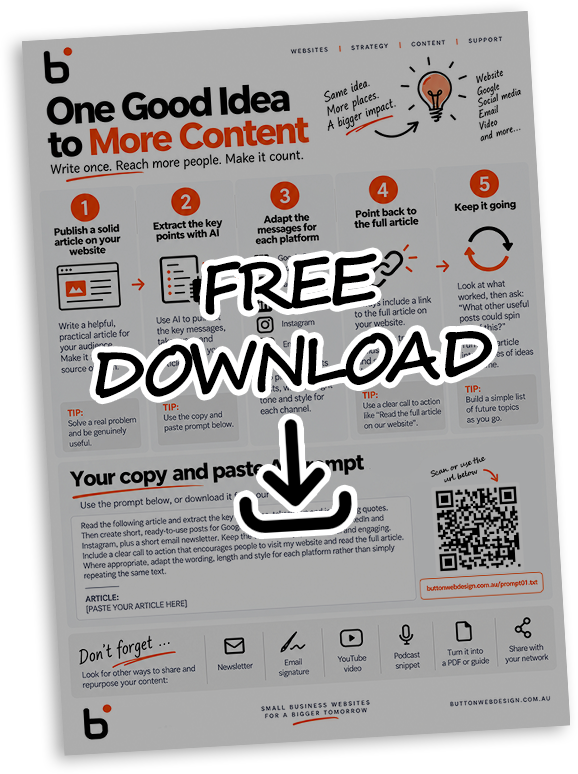
I’ve made you a cheat sheet
[click here to download it – it’s free]
Because there’s a problem with articles like this.
You read them, think that’s a good idea, and three months later you can’t remember what the process was.
So I’ve turned the whole thing into a simple One Good Idea to More Content guide.
Keep it on your computer. Print it out. Stick it near your desk.
The process is deliberately simple:
- Publish one genuinely useful article on your website.
- Extract the strongest ideas and messages with AI.
- Adapt them for the platforms you actually use.
- Point people back to the complete article where appropriate.
- Keep going by looking for the next useful idea hiding inside the first one.
That’s it.
You don’t need to create five completely original pieces of content every week.
You need to get better at recognising the value in the good ideas you already have.
You probably have more to talk about than you think
This is something I see with clients all the time.
When you’re inside a business every day, the things you know can seem completely ordinary.
They’re not ordinary to your customers.
The question somebody asked you yesterday.
The problem you solved last week.
The mistake you regularly help customers avoid.
The new product you’ve started using.
The reason you do something differently from your competitors.
The piece of advice you find yourself repeating over and over again.
That’s content.
Sometimes you just need somebody outside the business to recognise it.
That’s a big part of how I work with clients at Button Web Design. I’m not only interested in building the website. I’m interested in what the business is trying to achieve and how the website, content, search, social media and the other tools available to us can work together to help achieve it.
And very often, the answer isn’t create more stuff.
It’s:
Make much better use of the good stuff you’ve already got.