
The Power of a Mailing List: Why Your Business Should Be Building One
Social media trends change, posts disappear down people’s feeds, and algorithms decide what gets seen. A mailing list gives your business a more direct way to stay connected with customers.
Imagine spending years building an audience on Facebook or Instagram, only to discover that fewer and fewer people are seeing your posts.
You’ve invested time creating content, sharing photographs, promoting your services and attracting followers. But every time you publish something, you’re relying on a social media platform to decide who gets to see it.
Now imagine having a list of customers and interested people who have actually asked to hear from your business.
You can send them useful advice, business news, new product information and updates directly by email.
That’s the value of building a mailing list.
And despite all the attention given to social media, email remains a widely used communication channel.
Email Marketing Is Far From Dead
Consider these two statistics:
76.4% — Email is still widely used.
According to GWI research reported by DataReportal, 76.4% of online adults worldwide had used email within the previous 30 days.
35.9% — Average email open rate.
The UK’s Data & Marketing Association reported an average email open rate of 35.9% in its 2025 Email Benchmarking Report.
These figures come from different research sources and aren’t guarantees of what your business will achieve. Results vary depending on your industry, audience and the quality of your content. Email open rates can also be inflated by privacy features that automatically register opens.
But the numbers tell us something important.
Email remains a relevant way for businesses to communicate with customers.
And you don’t need thousands of subscribers to make it worthwhile.
Imagine having just 500 people on your mailing list. These might be previous customers, regular customers and prospective customers who have expressed an interest in what you do.
Even if only a small percentage respond to your newsletter, those interactions could generate valuable enquiries, repeat purchases or recommendations.
For some businesses, one worthwhile enquiry could be worth considerably more than hundreds of casual social media views.
The question isn’t whether you should abandon social media.
It’s whether you should also be building a more direct way to stay connected with your customers.
Social Media Changes. Your Mailing List Stays With You.
Think about how much social media has changed over the years.
Platforms come and go. Some become enormously popular, while others gradually lose their audiences.
Remember when MySpace was everywhere? Or when businesses were encouraged to build audiences on platforms that are barely discussed today?
The platforms people use now might not be the ones they’re using five years from now.
Even established platforms continually change how they work.
Their algorithms determine which posts appear in people’s feeds, and businesses have limited control over how widely their content is distributed.
You might spend considerable time creating an interesting Facebook or Instagram post, only for a small percentage of your followers to see it.
And even when somebody does see your post, how easily can they find it again?
Social media feeds move quickly.
Today’s interesting article, photograph or business announcement is soon buried beneath hundreds of other posts.
Unless somebody remembers your business and deliberately goes looking, that content can effectively disappear from view.
That’s not to say social media isn’t valuable. It absolutely has a place in your digital marketing.
But building your entire customer communication strategy around platforms you don’t control is a risk.
A mailing list provides something different.
When somebody subscribes to your e-newsletter, they’re giving you permission to communicate with them directly.
You can send information to their inbox without relying on a social media algorithm to decide whether your post appears in their feed.
Of course, that doesn’t guarantee they’ll open or read every email. Inbox filtering and subscriber interest still matter.
But an email can remain in somebody’s inbox, where they may be able to find it again later.
And provided you maintain appropriate subscriber records and permissions, you can generally export your mailing list and move to another email marketing service if you need to.
Social media is excellent for reaching new people. A mailing list helps you maintain a more direct relationship with people who’ve already shown an interest in your business.
The two can work together beautifully.
Your Existing Customers Are Worth Keeping in Touch With
When businesses think about marketing, the conversation often focuses on attracting new customers.
But what about the people who have already bought from you?
They know your business. They’ve experienced your products or services. And, hopefully, they’ve had a positive experience.
Yet it’s surprisingly easy to lose touch.
Perhaps they don’t need your services again immediately. Maybe they only buy something every couple of years. Or perhaps they simply get busy and forget about you.
An occasional e-newsletter gives you a reason to reconnect.
You might share some useful advice, introduce a new service, show a recently completed project or remind customers about something seasonal.
You’re not necessarily asking them to buy something every time you contact them.
You’re simply keeping your business familiar and giving them useful reasons to remember you.
And when they do need your services again, or somebody asks them for a recommendation, your business is more likely to come to mind.
Sometimes the most valuable marketing opportunity isn’t finding a new customer. It’s staying connected with somebody who already knows you.
What Would You Actually Put in a Newsletter?
This is one of the first questions business owners ask when I mention email newsletters.
And it’s a fair question.
Nobody wants to receive an email that says little more than, “Hello, we’re still here. Please buy something.”
But most businesses have far more interesting things to talk about than they realise.
Your newsletter could include:
- Useful advice and practical tips
- News about your business
- New products or services
- Recently completed projects
- Customer stories and testimonials
- Industry news that affects your customers
- Seasonal reminders
- Upcoming events
- Answers to frequently asked questions
- Links to useful articles on your website
You don’t need to include everything in every newsletter.
A short, useful email with two or three interesting items can be perfectly adequate.
And here’s something that makes the process considerably easier.
You may already have most of your newsletter content sitting on your website.
Your Website Blog Can Provide the Content for Your Newsletter
If you regularly publish blog posts, business news, useful advice, project updates or customer stories, you’ve already got material you can share with your mailing list.
And you don’t need to reproduce the entire article in your email.
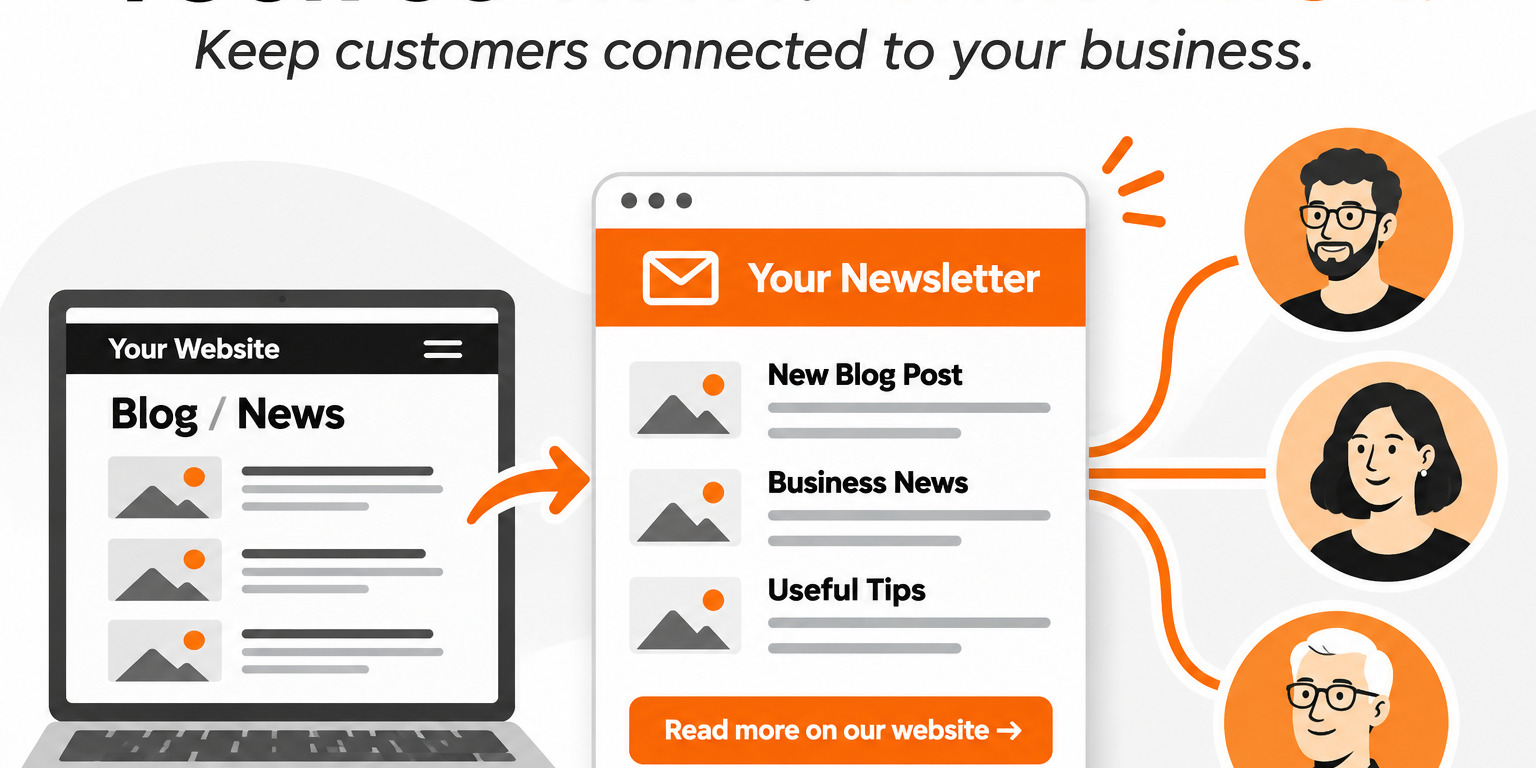
Using a platform such as Mailchimp, you can create an attractive, branded e-newsletter featuring the titles of your latest website articles, a short introduction to each one and a link inviting readers to find out more.
For example, a Button Web Design newsletter might feature three articles:
The Hidden Cost of a Cheap Website
A cheap website isn’t necessarily a bargain. Here’s what business owners should consider beyond the initial price.
Your Website Is Only One Piece of the Digital Marketing Puzzle
A good website is important, but how do Google, social media, content and other marketing activities fit together?
One Good Idea Can Give You Weeks of Content
Discover how a single useful website article can provide material for several different marketing channels.
Each introduction would include a link to read the full article on the website.
And this is where things get particularly interesting.
When somebody clicks through to read an article, they’re back on your website.
While they’re there, they might explore your services, look at examples of your work, discover another useful article or decide to contact you.
Your newsletter isn’t just sharing information.
It’s creating opportunities to bring interested people back to your website, where they can discover everything else your business has to offer.
And the relationship works both ways.
Your website can include a newsletter subscription form, giving visitors who enjoy your content the opportunity to sign up for future updates.
The process becomes quite simple:
Write useful articles on your website → Feature them in your e-newsletter → Bring readers back to your website → Give them opportunities to explore your business.
You’re not creating an entirely new set of content every time you send a newsletter.
You’re making better use of the knowledge, news and advice you’re already publishing.
That’s a much more manageable approach for a busy small business owner.
Your Website, Social Media and Newsletter Can Work Together
This is something I’ve talked about in another Lessons From The Lab article, Your Website Is Only One Piece of the Digital Marketing Puzzle.
The different parts of your online presence shouldn’t operate in isolation.
Imagine you’ve just completed an interesting customer project.
You could publish a story about the project on your website, including photographs, an explanation of the work and the result.
Then you could share a few photographs and a short introduction on Facebook or Instagram.
You might also write a LinkedIn post about an interesting challenge you encountered.
And when your next newsletter goes out, you could feature the project with a short summary and a link to the full story.
One project. Several opportunities to reach people.
And all of those activities can help direct interested readers back to your website.
Your website is where your content lives. Social media helps people discover it. Your newsletter helps bring people back.
It’s a simple idea, but one that can make your digital marketing much more coordinated.
How Do You Build a Mailing List?
The best place to start is often your own website.
You can include a newsletter subscription form in appropriate places, such as your website footer, blog pages or contact page.
You might invite visitors to subscribe for useful tips, business news or occasional updates.
You could also offer something worthwhile in return for subscribing, such as a practical checklist, guide or downloadable resource.
For example, a business selling gardening equipment might offer a seasonal garden maintenance checklist.
A professional services business might offer a guide answering common customer questions.
The important thing is giving people a clear reason to subscribe.
And your mailing list should be built properly.
In Australia, commercial electronic messages are subject to spam laws, including requirements around consent, sender identification and providing a functional unsubscribe facility.
You shouldn’t simply collect email addresses from websites or add everybody you’ve ever met to a marketing list.
People need to have given appropriate consent to receive your communications.
A smaller list of genuinely interested subscribers is far more useful than a large collection of people who never wanted your emails in the first place.
How Mailchimp Makes It Manageable
Mailchimp is an email marketing platform that helps businesses create, send and manage e-newsletters.
Rather than sending a newsletter manually from your ordinary email account, you can use Mailchimp to manage subscribers and produce professionally presented emails.
Some of its useful features include:
- Branded newsletter templates
- Subscriber lists and audience management
- Website subscription forms
- Scheduling newsletters
- Reusable email layouts
- Links to website articles and other content
- Reports showing email engagement
- Unsubscribe management
One of the things I particularly like is the ability to create a consistent newsletter design.
Your business logo, colours, typography and overall presentation can be incorporated into a reusable template.
That means you don’t have to design everything from scratch whenever you want to send an update.
You can concentrate on the content.
Mailchimp also provides reporting tools that help you understand how people are engaging with your emails.
For example, you can see which articles attracted clicks and use that information to help plan future content.
If an article about a particular service attracts considerable interest, that might suggest a subject worth exploring further.
And because the newsletter links back to your website, you can also use website analytics to better understand what visitors do after arriving.
How Often Should You Send a Newsletter?
There’s no single answer that suits every business.
Some businesses have enough relevant news and information to send a newsletter every week.
Others might be better suited to a monthly or even quarterly update.
I wouldn’t recommend sending newsletters simply to meet an arbitrary schedule.
It’s better to send something useful occasionally than to send frequent emails that people have little interest in reading.
For many small businesses, a monthly newsletter could be a sensible starting point.
That gives you time to publish a few website articles, collect business news and prepare something worthwhile.
And once you have a reusable Mailchimp template and a simple process for collecting content, the whole exercise becomes much easier.
A Mailing List Is Something You Build Over Time
One of the mistakes businesses can make is expecting immediate results.
You might start with only a handful of subscribers.
That’s fine.
Every relevant subscriber represents somebody who has expressed an interest in hearing from your business.
Over time, your website, social media activity, customer communications and other marketing efforts can help grow that list.
And as the list grows, so does your ability to communicate with an audience that has chosen to stay connected.
Unlike a social media following, where visibility depends heavily on a platform’s changing rules, a permission-based mailing list gives you greater control over how and when you communicate.
You still need to earn people’s attention by sending worthwhile content.
But you’re building a communication channel that can continue supporting your business for years.
You Don’t Have to Do Everything Yourself
I appreciate that most small business owners have enough to do without adding another marketing task to their week.
Writing articles, preparing newsletters, managing subscriber lists and keeping everything looking professional takes time.
That’s where I can help.
At Button Web Design, my work goes beyond building and maintaining websites.
I can help businesses develop useful website content, publish blog posts and news articles, create branded Mailchimp newsletter templates and prepare e-newsletters that bring readers back to their websites.
I can also help connect newsletter subscription forms to websites and look at how email fits into the business’s wider online strategy.
The aim isn’t to create more work for you.
It’s to make better use of the information, knowledge and activities your business already has.
Start Building a Connection That Lasts
Social media will continue to change.
New platforms will emerge. Existing platforms will evolve. Algorithms will change, and today’s popular way of reaching customers might not be as effective tomorrow.
Your website and mailing list provide a more stable foundation for your digital marketing.
Your website gives you somewhere to publish useful, lasting content.
Your mailing list gives you a way to stay in touch with people who have asked to hear from you.
And your e-newsletter provides a simple way to bring those people back to your website, where they can discover more about your business.
You don’t need thousands of subscribers, and you don’t need to send a newsletter every week.
You just need to start building a relevant list and give people worthwhile reasons to stay subscribed.
Could an E-Newsletter Work for Your Business?
If you’ve been thinking about starting an email newsletter but aren’t sure where to begin, I can help.
Whether you need a Mailchimp account set up, a professionally branded newsletter template, subscription forms on your website or assistance creating the content itself, Button Web Design can help you put the pieces together.
And if you’re already publishing useful articles or business news on your website, you may have much of the material you need to get started.
Let’s make your website content work harder and give your customers a reason to keep coming back.
Research Sources
- DataReportal — Global Digital Research — Global email usage research.
- DMA — Email Benchmarking Report 2025 — UK email engagement benchmarks.
- ACMA — Avoid Sending Spam — Australian commercial email requirements.
Call 0431 269 804 or email me at matt@buttonwebdesign.com.au or use the Quick form to let me know your thoughts.
Quick Form